






By Tiffany Medois | Licensed Esthetician, MPH
I’ve been something of a carrot-juice junkie over the years.
Whenever my skin started acting up, particularly when I was dealing with acne, carrot juice became one of the first things I reached for. And I don’t mean an occasional sip. There were times when I drank it as often as three times a day.
What I noticed was remarkable. My breakouts would settle, sometimes clearing altogether, and my skin seemed to take on a beautiful radiance. That glow was hard to miss.
Of course, there was often another issue waiting for me: the dark marks left behind after the acne disappeared. Anyone who has dealt with post-inflammatory hyperpigmentation knows that clearing a breakout and clearing its aftermath can be two very different journeys.
Still, I never forgot what carrot juice seemed to do for my skin.
As a Licensed Esthetician with a background in public health, I’ve learned to hold two things together: the value of personal experience and the importance of scientific evidence. I know what I observed in my own skin. I also know that an individual experience, however convincing, doesn’t prove that a particular food or drink caused the improvement.
But it can inspire a very good question.
What if some of the things we eat are helping our skin in ways we’re only beginning to understand?
A newly published 2026 study offers an intriguing place to start.
The New Research: A Closer Look at Carotenoids
In September 2026, researchers published a randomized, double-blind, placebo-controlled clinical trial in Frontiers in Aging examining whether a blend of carotenoids could improve skin health.
The study followed 80 healthy women between the ages of 40 and 55. Participants received either a mixed-carotenoid supplement or a placebo daily for 12 weeks.
The researchers measured everything from wrinkles and hydration to skin-barrier function, dermal thickness, and carotenoid levels within the skin itself.
The findings were interesting, although perhaps not in the way a beauty advertisement might lead you to expect.
Women who received the carotenoid supplement experienced a substantial increase in measurable skin carotenoid levels. Researchers also found improvements in certain measures of skin-barrier function and dermal thickness compared with the placebo group.
But here’s the important part: the researchers did not find significant improvements in the visible signs of skin aging, including wrinkles, pigmentation, or elasticity, over those 12 weeks.
In other words, something appeared to be happening beneath the surface, even though those changes didn’t necessarily translate into a visibly younger-looking face.
That distinction matters.
The study suggests that carotenoids may support aspects of healthy skin function. It does not establish that taking carotenoid supplements will erase wrinkles, clear acne, or make skin visibly radiant.
It was also a relatively small, short study involving a particular supplement formulation, not a trial of carrot juice or whole vegetables.
Research: CaroRite for Improving Skin Health and the Visible Signs of Aging, Frontiers in Aging, 2026.
So, What Exactly Are Carotenoids?
You already know them by their colors.
They’re responsible for many of the beautiful yellow, orange, and red hues found in fruits and vegetables. Some are also present in dark leafy greens, where chlorophyll makes their colors less obvious.
Carotenoids are naturally occurring pigments with important biological functions. Several have antioxidant activity, and certain carotenoids can be converted by the body into vitamin A, a nutrient essential for normal skin and immune function.
Among the most familiar are:
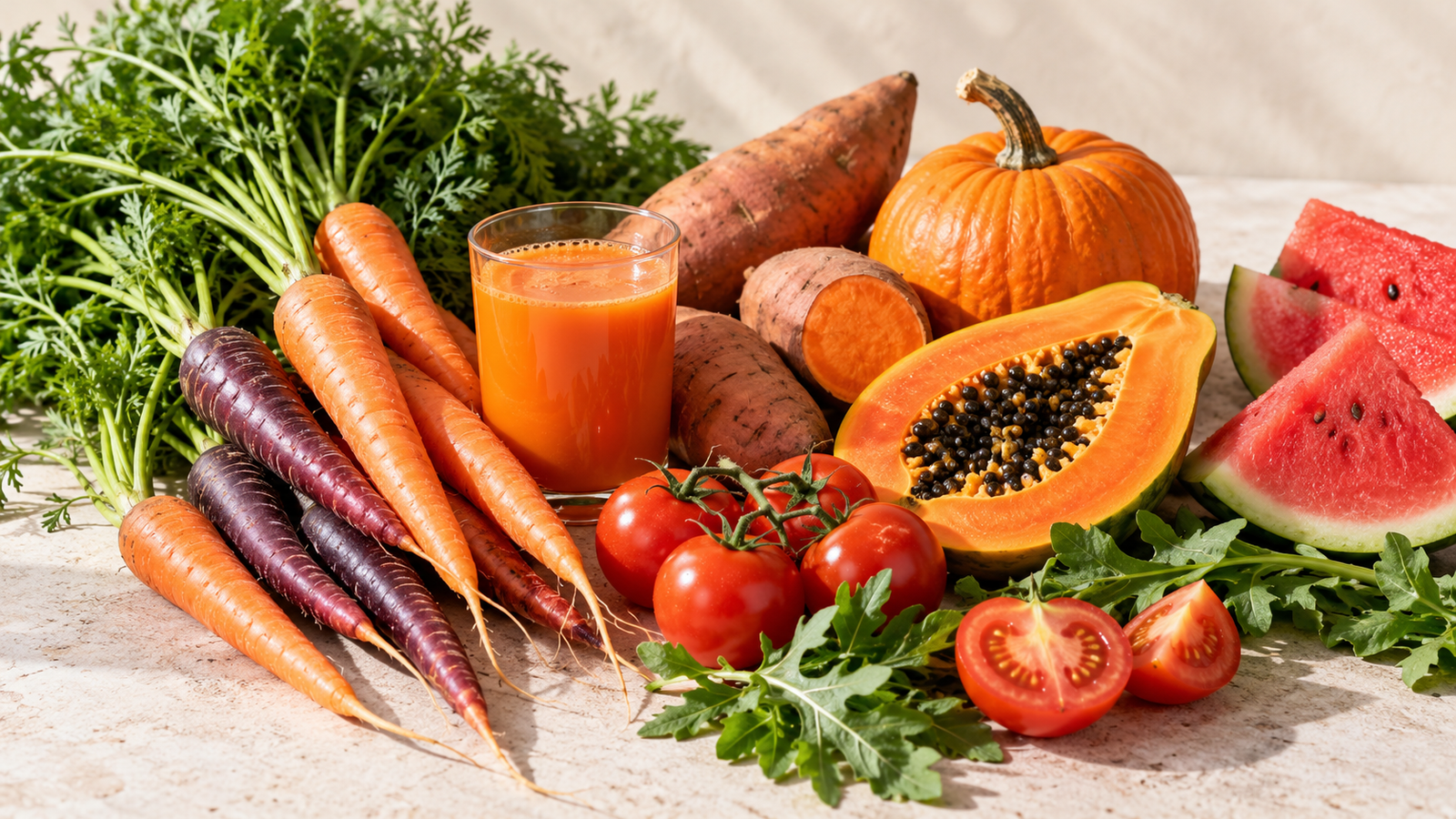
- Beta-carotene: Found in carrots, sweet potatoes, pumpkin, and dark leafy greens. The body can convert it into vitamin A.
- Alpha-carotene: Found in carrots, winter squash, and other colorful vegetables.
- Lycopene: Found in tomatoes, watermelon, and pink grapefruit.
- Lutein and zeaxanthin: Found in leafy greens, corn, and certain yellow-orange foods.
- Beta-cryptoxanthin: Found in foods such as papaya and certain citrus fruits.
These compounds aren’t interchangeable, and they don’t all work in exactly the same way.
But together, they help explain why eating a variety of colorful plant foods may have advantages that no single vegetable or supplement can fully replicate.
What Does This Have to Do With Your Skin?
Your skin is constantly responding to its environment.
Ultraviolet radiation, pollution, inflammation, and normal metabolic processes can contribute to oxidative stress. This happens when reactive molecules overwhelm the body’s ability to keep them in balance.
Over time, oxidative stress can contribute to processes involved in skin aging and inflammation.
Carotenoids are among the dietary compounds researchers are studying for their potential to support the body’s antioxidant defenses.
A 2025 systematic review of 176 studies examined the relationship between carotenoids and skin aging, including their antioxidant, anti-inflammatory, and photoprotective properties.
The overall findings were promising, but the studies varied considerably. Some involved people, others involved animals or laboratory models, and not every finding can be translated directly into advice about what to eat.
A separate 2026 review of micronutrients and skin resilience reached a similarly measured conclusion: carotenoids and certain antioxidant nutrients may support the skin’s response to environmental stress, but they shouldn’t be mistaken for treatments that reverse aging.
And no matter how colorful your diet becomes, food-derived antioxidants are not a substitute for sunscreen.
Research: Skin Aging and Carotenoids: A Systematic Review, 2025 and Skin Resilience and Biological Adaptability, 2026.
But Can Carrot Juice Actually Clear Acne?
Now we’re getting to the question that first captured my attention.
I know what happened when I drank carrot juice consistently. My skin looked clearer, and the improvement often seemed significant.
But does scientific research establish carrot juice as an acne treatment?
Not yet.
Acne is a complex inflammatory skin condition influenced by factors including hormones, sebum production, follicular processes, and the skin’s microbial environment.
Diet may also play a role, although the evidence is still developing.
A 2026 review published in the Journal of the European Academy of Dermatology and Venereology examined the relationship between diet and acne. Researchers discussed evidence involving glycemic load, dairy, omega-3 fatty acids, and broader dietary patterns, while emphasizing that more rigorous intervention studies are needed.
They did not establish carrot juice as an effective treatment for acne.
So how should we interpret experiences like mine?
It’s possible that dietary changes influence some people’s skin through multiple pathways. It’s also possible that other changes occurring at the same time, from stress and hormones to overall eating patterns, contribute to the results.
There is not enough evidence to identify carotenoids as the reason my breakouts improved.
The experience is worth sharing. The conclusion deserves caution.
If carrot juice is part of a balanced diet and you enjoy drinking it, that’s one thing. Replacing appropriate acne treatment with large quantities of juice is another.
Research: Diet and Acne: Facts and Controversies, 2026.
The Glow Might Be More Than a Feeling
Here’s another reason I find this subject fascinating: researchers have demonstrated that changing carotenoid intake can measurably change carotenoid concentrations in the skin.
In a 2024 randomized feeding trial, 80 adults ages 20 to 49 were assigned to diets containing different amounts of carotenoids. Researchers measured carotenoid levels in both the blood and skin to better understand how dietary changes appeared in the body.
A separate randomized study involving young women found that consuming more carotenoid-rich fruits and vegetables increased measured skin yellowness over four weeks, without a corresponding change in skin lightness.
That doesn’t mean everyone should expect a golden glow, and it certainly doesn’t mean these nutrients lighten the skin.
It means compounds from colorful foods can accumulate in skin tissue and influence measurable aspects of its appearance.
The way those changes look, if they’re visible at all, may differ depending on an individual’s natural pigmentation and other characteristics.
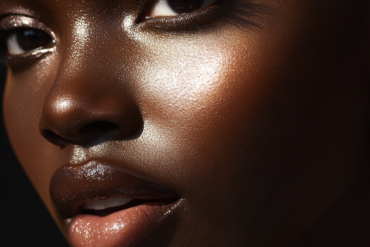
This is particularly important when we’re discussing melanin-rich skin, where the language of radiance should never become another version of the idea that lighter skin is better skin.
For me, radiant skin means skin that looks healthy, comfortable, and beautifully itself.
Research: Skin Carotenoid Status and Dietary Intake, Nutrition, 2024 and High-Carotenoid Fruits and Vegetables in Young Women, 2016.
Does This Apply Only to Women Over 40?
Absolutely not.
The new 2026 clinical trial specifically studied women ages 40 to 55, so its particular findings cannot automatically be extended to teenagers, women in their 20s, or other age groups.
But carotenoids are important dietary compounds throughout life.
You don’t have to wait until your 40s to begin thinking about how nutrition supports your skin. The body needs adequate nourishment during adolescence, adulthood, and beyond.
And research involving younger adults has shown that carotenoid intake can affect measurable skin carotenoid concentrations.
For teenagers and women in their 20s, however, that shouldn’t be translated into a recommendation to begin taking anti-aging supplements.
A varied, nourishing diet is a much more appropriate starting point.
Healthy skin isn’t something we suddenly begin caring for when our first fine line appears. It’s part of how we care for ourselves across a lifetime.
My Latest Discovery: Purple Carrots
Just when I thought my love affair with carrots couldn’t get more interesting, I recently discovered purple carrots.
And naturally, I became curious.
We’ve all seen the familiar bright-orange carrot, but carrots also come in purple, yellow, red, and even white varieties.
What makes purple carrots particularly interesting is their content of anthocyanins, a family of plant pigments also found in foods such as blueberries, blackberries, and purple cabbage.
These compounds are different from carotenoids, although some purple carrot varieties contain carotenoids as well.
Research published in Food Chemistry: X in 2025 examined the anthocyanins and other phenolic compounds present in a large collection of purple carrots. The researchers found especially high anthocyanin concentrations in fully purple roots.
This makes purple carrots an interesting addition to a varied diet, but there’s an important distinction.
Purple carrots aren’t automatically better for your skin than orange carrots.
Their nutritional profiles differ by variety. Some orange carrots are particularly rich in beta-carotene, while certain purple carrots offer additional anthocyanin pigments.
And although anthocyanins are being studied for their biological activities, there isn’t convincing human clinical evidence showing that purple carrot juice produces clearer skin, reduces acne, or improves hyperpigmentation more effectively than ordinary carrot juice.
Still, I’m intrigued.
I haven’t decided what my purple-carrot experiment will look like yet, but they’re certainly on my list of foods to explore.
Sometimes curiosity is simply the beginning of learning something new.
Research: Characterization of Anthocyanins in Purple Carrots, Food Chemistry: X, 2025.
As much as I love carrot juice, I wouldn’t want anyone to leave this article believing that drinking it three times a day is the secret to beautiful skin.
That isn’t what the evidence says.
In fact, a dietary pattern that includes different plant foods may provide a broader variety of nutrients and bioactive compounds than any single juice.
Consider the possibilities:
- Orange carrots and sweet potatoes for beta-carotene and other carotenoids.
- Tomatoes and watermelon for lycopene.
- Spinach, kale, and other leafy greens for lutein and additional nutrients.
- Purple carrots, blueberries, and blackberries for anthocyanins.
- Red and yellow peppers for carotenoids and vitamin C.
You can enjoy these foods raw, cooked, in salads, blended into smoothies, or sometimes as juice.
Whole vegetables and fruit generally provide more fiber than strained juices, while some carotenoids are absorbed more readily when foods are prepared appropriately and eaten with some fat.
There’s room for carrot juice in an enjoyable, balanced diet. It simply doesn’t need to become a prescription.
And more isn’t always better. Drinking large quantities of carotenoid-rich juices over time can sometimes cause a temporary yellow-orange discoloration of the skin, called carotenemia. High-dose beta-carotene supplements carry additional concerns, particularly for people who smoke or formerly smoked.
Nutrition should nourish us, not become another beauty obligation.
What About Hyperpigmentation?
This deserves its own conversation, especially for those of us whose breakouts leave behind dark marks.
Post-inflammatory hyperpigmentation develops when inflammation stimulates excess pigment production in the skin. It can follow acne, irritation, or other inflammatory conditions, and it may persist long after the original inflammation has resolved.
Although healthy nutrition supports overall skin function, there isn’t adequate evidence that drinking carrot juice or increasing carotenoid intake will fade established dark marks.
That was certainly my experience. Even when I felt my carrot juice routine helped my acne settle, the hyperpigmentation often remained.
Managing those marks may involve preventing new inflammation, using appropriate skincare ingredients, protecting the skin from ultraviolet and visible light, and seeking professional guidance when needed.
It’s worth remembering that a healthy diet and an effective skincare routine don’t have to compete with each other.
They simply serve different purposes.
So, Can You Really Nourish Your Skin From Within?
I believe the answer is yes, with an important qualification.
Nutrition is essential to normal skin health, and research continues to reveal ways that dietary nutrients participate in the processes that help skin function.
What science hasn’t established is that drinking carrot juice, eating a particular vegetable, or taking a carotenoid supplement will give everyone clearer, younger-looking, or more radiant skin.
Those are different claims, and they deserve different levels of evidence.
For me, carrot juice remains something personal. I’ve seen changes in my own skin that made me pay attention, and those experiences helped deepen my curiosity about nutrition and skin health.
Now, with new research exploring carotenoids, skin-barrier function, and the relationship between food and skin biology, I have even more reasons to keep asking questions.
And yes, I’m still interested in those purple carrots.
Perhaps the beauty of nourishing our skin from within isn’t about discovering one miraculous ingredient.
Perhaps it’s about appreciating how much our skin is connected to the rest of us, and giving our bodies a beautiful variety of what they need to thrive.
Research & Further Reading
- Rao A, Pellow J, Briskey D. (2026). CaroRite for Improving Skin Health and the Visible Signs of Aging: A Randomised, Double-Blind, Placebo-Controlled Trial. Frontiers in Aging.
- Skin Aging and Carotenoids: A Systematic Review of Their Multifaceted Protective Mechanisms. (2025).
- Skin Resilience and Biological Adaptability: Current Clinical Evidence on Micronutrients and Bioactive Compounds. (2026).
- Dessinioti C, Dreno B. (2026). Diet and Acne: Facts and Controversies. Journal of the European Academy of Dermatology and Venereology.
- Ahn S, et al. (2024). Examination of the Utility of Skin Carotenoid Status in Estimating Dietary Intakes of Carotenoids and Fruits and Vegetables. Nutrition.
- Pezdirc K, et al. (2016). Consuming High-Carotenoid Fruit and Vegetables Influences Skin Yellowness and Plasma Carotenoids in Young Women. Journal of the Academy of Nutrition and Dietetics.
- Characterization of Anthocyanins, Phenolics, and Flavonoids in a Global Carrot Collection. (2025). Food Chemistry: X.
Editorial note: The author’s experience with carrot juice is a personal observation, not clinical evidence that carrot juice treats acne. This article is for educational purposes and is not a substitute for individualized dermatological or nutritional care.